Which shield infantry performs the best against other shield infantry units?
Matthew Dane, 3/9/2024
Introduction
In the realm of ‘Mount & Blade II: Bannerlord’, the choice of infantry units can significantly impact the outcome of battles. Shield-wielding infantry units are the backbone of any army in Bannerlord. They control the flow of combat, push towards the enemy, and prevent the enemy’s advancement. They clash against opposing shield infantry units, and the outcome from that skirmish often decides the rest of the battle.
A recent analysis by StratGaming shed light on the performance of the shield infantry units in the game. While insightful, I believe that there is more to learn from his data. Using the data provided by StratGaming, I conducted my own analysis to see how the shield infantry units perform against each other. This article evaluates the kill-to-death ratio (KDR) and the win rates between each shield infantry unit within Bannerlord.
Data Overview
StratGaming’s data collection process involved a systematic approach to simulating consistent battles of 250 versus 250 shield infantry units. He conducted a series of battles where each shield infantry unit, such as the Legionary, faced off against every other shield infantry unit. Each matchup of units consisted of 10 battles to ensure a robust sample size for analysis. For example, the Legionary unit fought the Veteran Infantry 10 times, then the Oathsworn 10 times, and so on. This careful approach to data collection aimed to capture a comprehensive and consistent representation of each shield infantry unit’s performance against various infantry in combat.
The assumption is that a Bannerlord player will fully upgrade their troops. That means that the units are at their maximum tier level, and testing was done on units at this level. The difference in tiers is the armor and weapon quality, and skill levels. For example, the Legionary is Tier 5 unit and has a one-handed weapon skill of 130 and wields a Steel Paramerion sword, while the Recruit is Tier 1 unit and has one-handed weapon skill is 20 and fights with a Pitchfork. There are also differences in skill and equipment between top-tier shield infantry units, for example the Veteran Infantry has a one-handed weapon skill of 160 and the Wildlings’ one-handed weapon skill is at 120.
There is a shield infantry unit that is unique to this dataset. The Mixed Infantry comprises lower-tier troops with their unit_count adjusted to 667. This adjustment is made to align their overall cost with that of higher-tier, fully-upgraded shield infantry units tested in this analysis. The unit cost, rather than unit count, is balanced to maintain a level of “fairness” in the comparison. StratGaming included Mixed Infantry because the player is more likely to face armies with varying tiers. It also provides an opponent with a larger troop count, which is later proved to be insightful.
The data also includes match ups with some non-infantry units, like the Imperial Crossbowmen, Fian Champions, Khan’s Guards, and Elite Cataphracts, recognizing that some of these units also carry shields. However, these units are not classified as melee infantry in Bannerlord. Imperial Crossbowmen are ranged infantry that carry a sword and a shield, Fian Champions are foot archers that carry a two-handed sword, Khan’s Guards are horse-riding archers that wield a two-handed polearm, and Elite Cataphracts are melee cavalry that use a sword and shield. To maintain a fair and controlled environment, he implemented specific rules for the battles: opponents with ranged weapons were given the “Hold Fire” command to prevent them from using their ranged capabilities, and mounted units like the Khan’s Guards and Elite Cataphracts were dismounted to standardize the combat conditions.
The dataset provided by StratGaming contains a range of fields that capture the performance of shield infantry units and non-infantry units:
- unit: The name of the shield infantry unit being tested.
- unit_count: The count of the shield infantry unit being tested.
- opponent: The name of the opposing unit in each test.
- opponent_count: The count of the opposing unit in each test.
- kills: The number of kills achieved by the unit.
- deaths: The number of times the unit was defeated.
- kill_rate: The kill-opponent count ratio, which is calculated by kills divided by the opponent_count.
- death_rate: The death-unit count ratio, which is calculated by the deaths divided by the unit_count.
- kdr: The kill-death ratio (KDR) which is the calculated by the kills divided by the deaths.
- status: The outcome of the battle (‘Win’ or ‘Loss’).
Methodology
In this analysis, I employed a combination of data processing techniques and statistical methods to evaluate shield infantry performance. The methodology included the following steps:
- Data Enhancement:
- I enhanced StratGaming’s dataset to improve its comprehensiveness and facilitate more robust analysis. The enhancements included:
- Adding Identifiers: I introduced additional columns, unit_id and opponent_id, to uniquely identify each unit and opponent, respectively. This addition aids in more precise data manipulation and referencing.
- Expanding Win/Loss logic: I refined the logic of the ‘status’ column by backfilling matches to accurately identify wins and losses. The original dataset only listed “Losses”, so this modification allows each record to be categorized as a win or a loss.
- Creating Reverse Matchup Logic: To normalize the data, I implemented logic to include reverse matchups. While StratGaming’s original data contained records for matchups like Legionary vs. Darkhan, it lacked the reverse, i.e., Darkhan vs. Legionary. Since the designation of ‘unit’ and ‘opponent’ is arbitrary in the context of data collection, I added records for these reverse matchups to maintain consistency in the dataset and analysis. This step involved backfilling the ‘kills’ and ‘deaths’ columns, inverting the win/loss status where necessary, and recalculating the ‘kill_rate’, ‘death_rate’, and ‘kdr’ for the new records.
- These enhancements ensure a more normalized dataset, reducing the potential for errors during data filtering or aggregation and providing a more solid foundation for in-depth analysis. You can find the data processing script here on GitHub.
- I enhanced StratGaming’s dataset to improve its comprehensiveness and facilitate more robust analysis. The enhancements included:
- Statistical Analysis:
- Aggregated on key performance metrics such as kill-death ratio (KDR) and win-loss ratio for each unit and match up.
- Identified outliers and applied filtering to remove data points that were more than 3 standard deviations from the mean, ensuring a more accurate analysis of central tendencies.
- Comparative Analysis:
- Conducted a comparative analysis of the average KDRs and win-loss ratios of each unit versus specific opponents to determine the relative effectiveness of each shield infantry unit.
Analysis
You can find the Python code to my analysis here.
Mean KDR for Each Unit
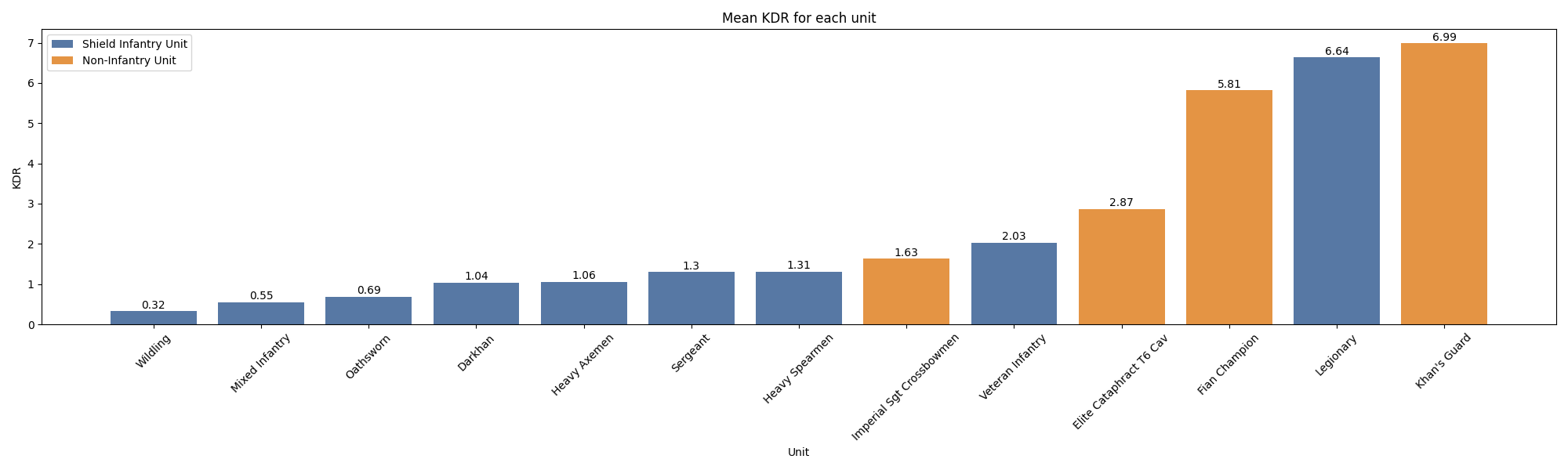
The bar chart below displays the mean KDR observed for every unit. Recall that there are units other than shield infantry units, such as the Khan’s Guards, Fian Champions, Elite Cataphracts, and Imperial Crossbowmen. They are categorized as non-infantry units for this analysis.
The units with the highest KDRs are Khan’s Guards, Legionaries, and Fian Champions, with KDRs of 6.99, 6.64, and 5.81, respectively. There is a significant drop to the fourth highest at 2.87. The top three units are evidently proficient fighters; however, it’s worth pointing out that two units are non-infantry units. The Khan’s Guards and Fian Champions are armed with two-handed weapons, whereas Legionaries are equipped with one-handed swords and shields. This may suggest that the use of two-handed weapons could enhance the melee efficiency—but that is worth its own, separate analysis.
On the lower end of the spectrum, Wildlings, Mixed Infantry, and Oathsworn each have a KDR of less than 1. The Wildlings, in particular, have performed below expectations.
Mean KDR for Each Unit Without Outliers
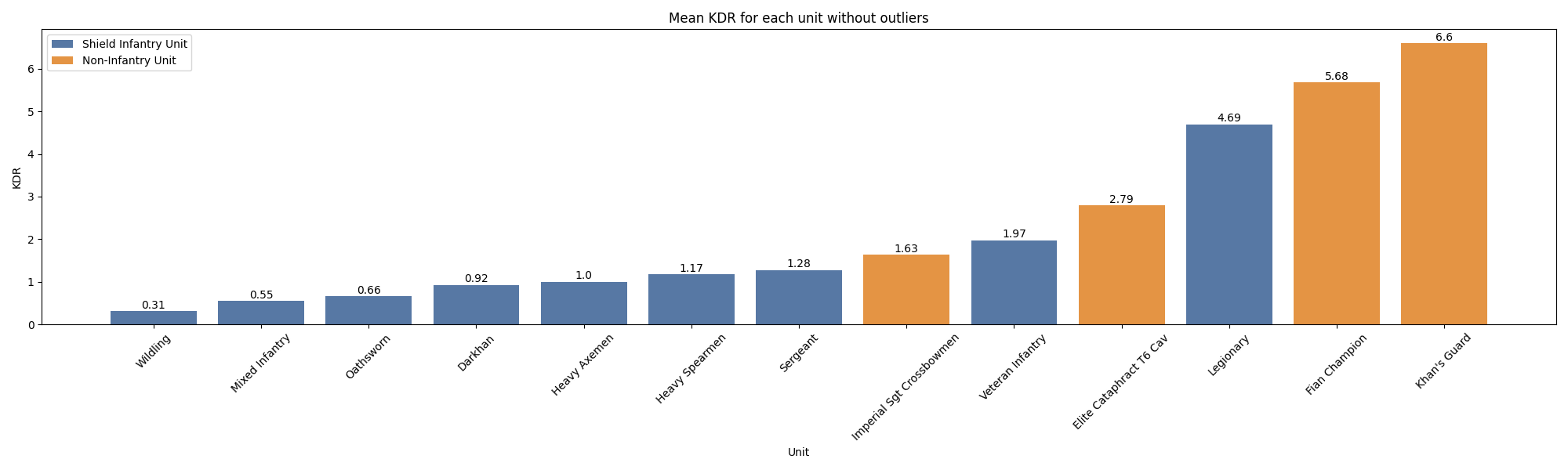
To enhance the accuracy of our analysis, outliers—defined as values beyond ±3 sigma (three standard deviations) from the mean—were removed from the dataset. This step helps to eliminate extreme anomalies that may skew the overall results. A ±2 sigma threshold was too restrictive, as it would result in a significantly smaller sample size.
Interestingly, despite outlier removal, the top-performing units—Khan’s Guards and Fian Champions—saw only a slight reduction in their KDR, from 6.99 to 6.6 and from 5.81 to 5.68, respectively. This suggests a consistent performance across their match-ups, with fewer extreme values that could overly inflate their numbers. In contrast, the Legionary’s KDR decreased more markedly, from 6.64 to 4.69, indicating that their initial high ranking was influenced by some exceptionally high KDRs.
The other units showed minimal changes in their KDR values post-outlier removal. One notable change was the Sergeant’s rise to the 7th position, nudging the Heavy Spearmen down to 8th. These observations reinforce the importance of scrutinizing outlier data, as they can significantly impact the perceived performance of units.
Mean KDR for Shield Infantry Units Only, Excluding Outliers
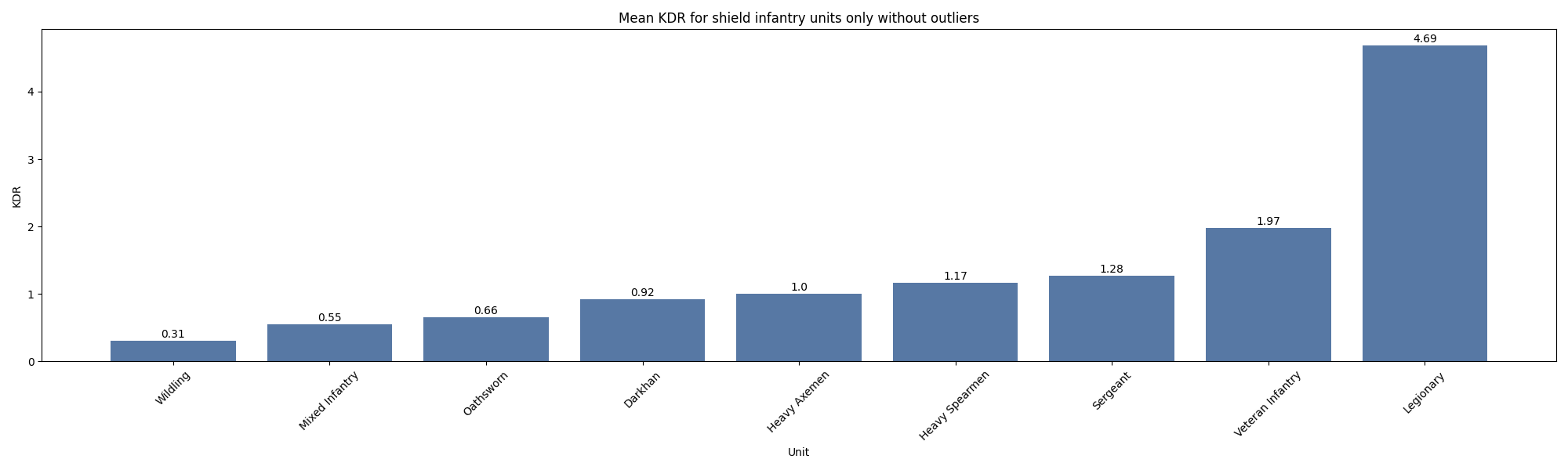
In isolating the data for shield infantry units and removing outliers, there is a stark contrast in performance. The bar chart emphasizes that the Legionary units lead with a remarkable KDR of 4.69, more than double that of the Veteran Infantry, which holds the second position with a KDR of 1.97.
Impact of Excluding Non-Infantry Unit Data
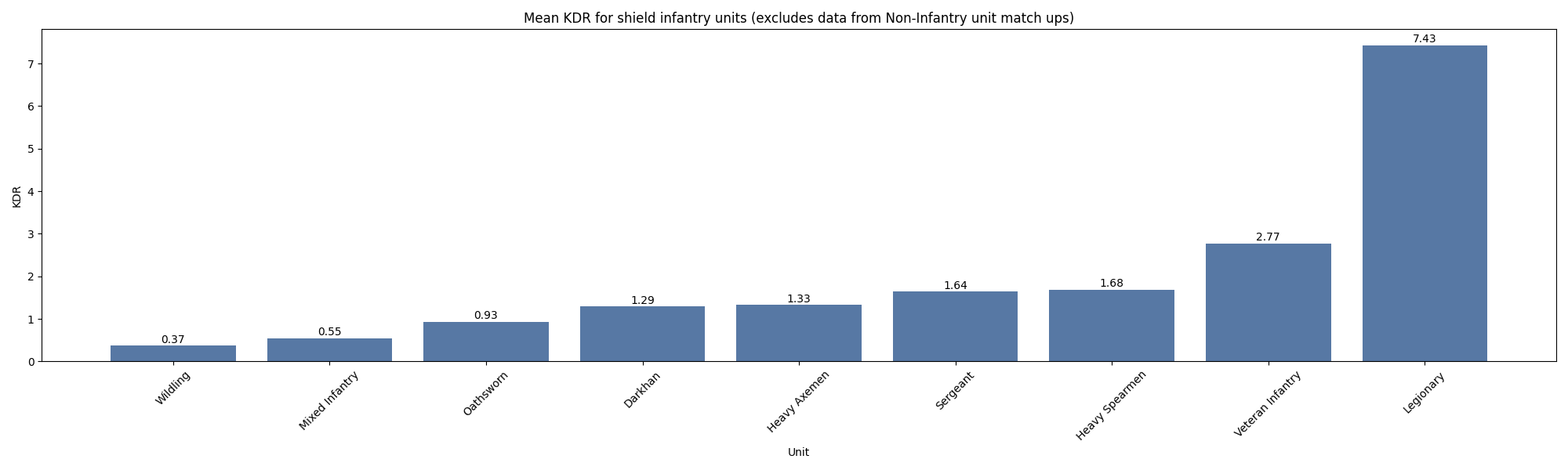
After excluding non-infantry units from the dataset and recalculating the mean KDR while omitting outliers, an interesting pattern emerged. I expected that all values would increase uniformly, but there was a significant increase seen in the Legionary, whose KDR soared from 4.69 to 7.43. The Veteran Infantry also saw an increase in KDR, albeit a modest one compared to the Legionary, from 1.97 to 2.77. Furthermore, the Heavy Spearmen reclaimed their third-place standing over the Sergeants. While increases in KDR values were anticipated following the removal of data from non-infantry units, the marginal rise for units at the lower end was unexpected. This suggests that their performance remains consistently lower, irrespective of the opposition.
Heatmap Analysis of Shield Infantry KDRs
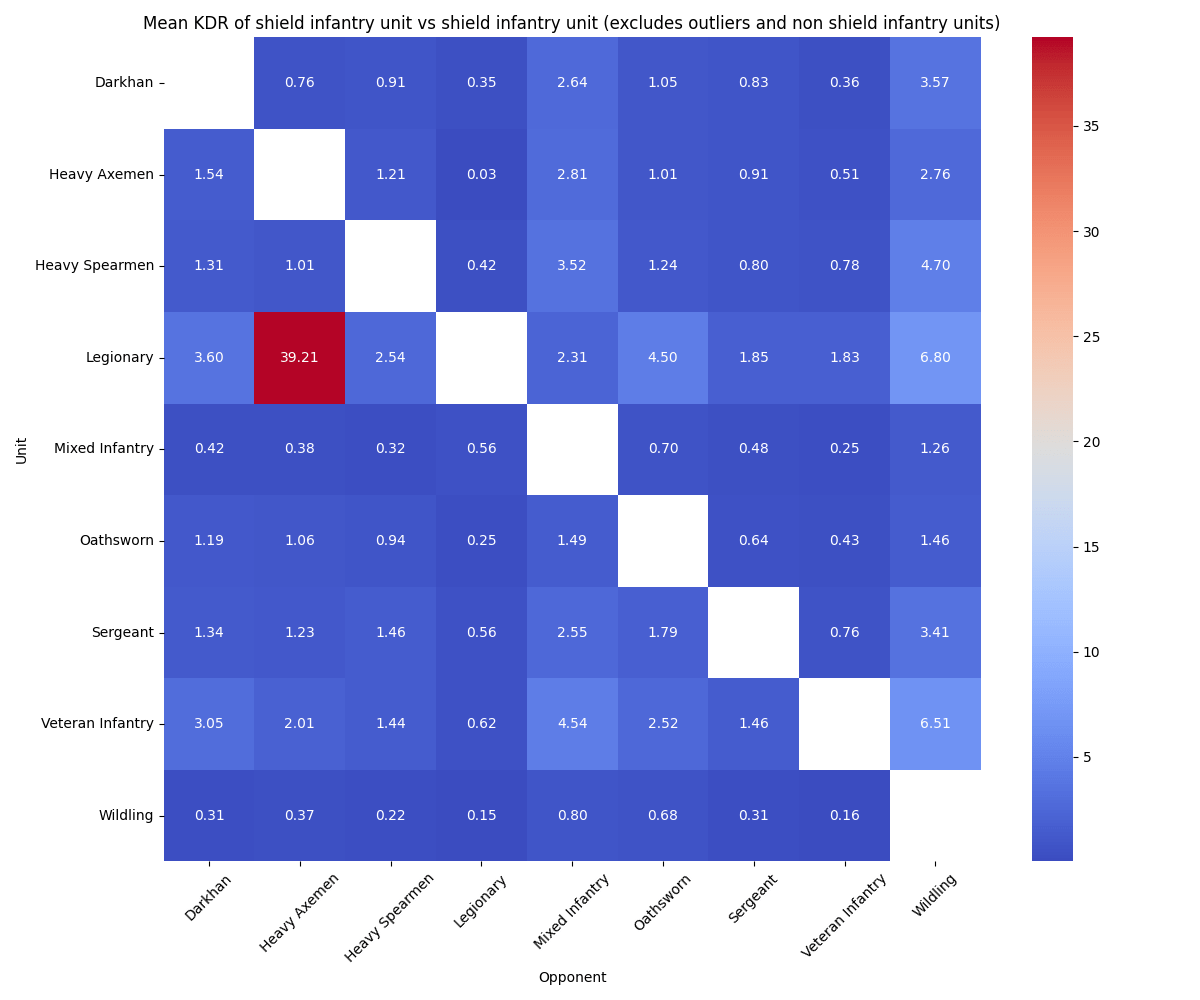
To get to the bottom of the Legionary units’ increased KDR, I dove into a heatmap based on the mean KDR for each shield infantry matchup. What stood out was a whopping KDR of 39.21 for Legionary against Heavy Axemen — this significantly boosts the Legionary’s overall KDR. This figure is an anomaly when you consider that most KDRs hover between 0.3 to 3.0. Even after filtering out the extremes, this particular matchup appears to be a substantial deviation. The heatmap a distinct contrast in coloration — a solitary red square surrounded by a sea of blues.
A Closer Look: Legionary Dominance Over Heavy Axemen
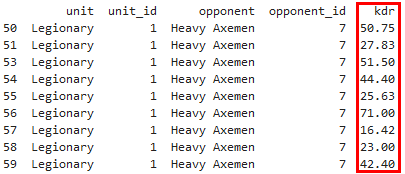
Zooming in on the specific encounters between the Legionary and the Heavy Axemen reveals a remarkable trend: the Legionary consistently trounce their opponents with KDRs of at least 16 and even more in nine matchups. This is significantly higher than what we see as an average for the Legionary in other confrontations. One matchup even reached such an extreme that it was excluded during the outlier removal phase due to surpassing the threshold of three standard deviations.
A Glimpse Without the Legionary
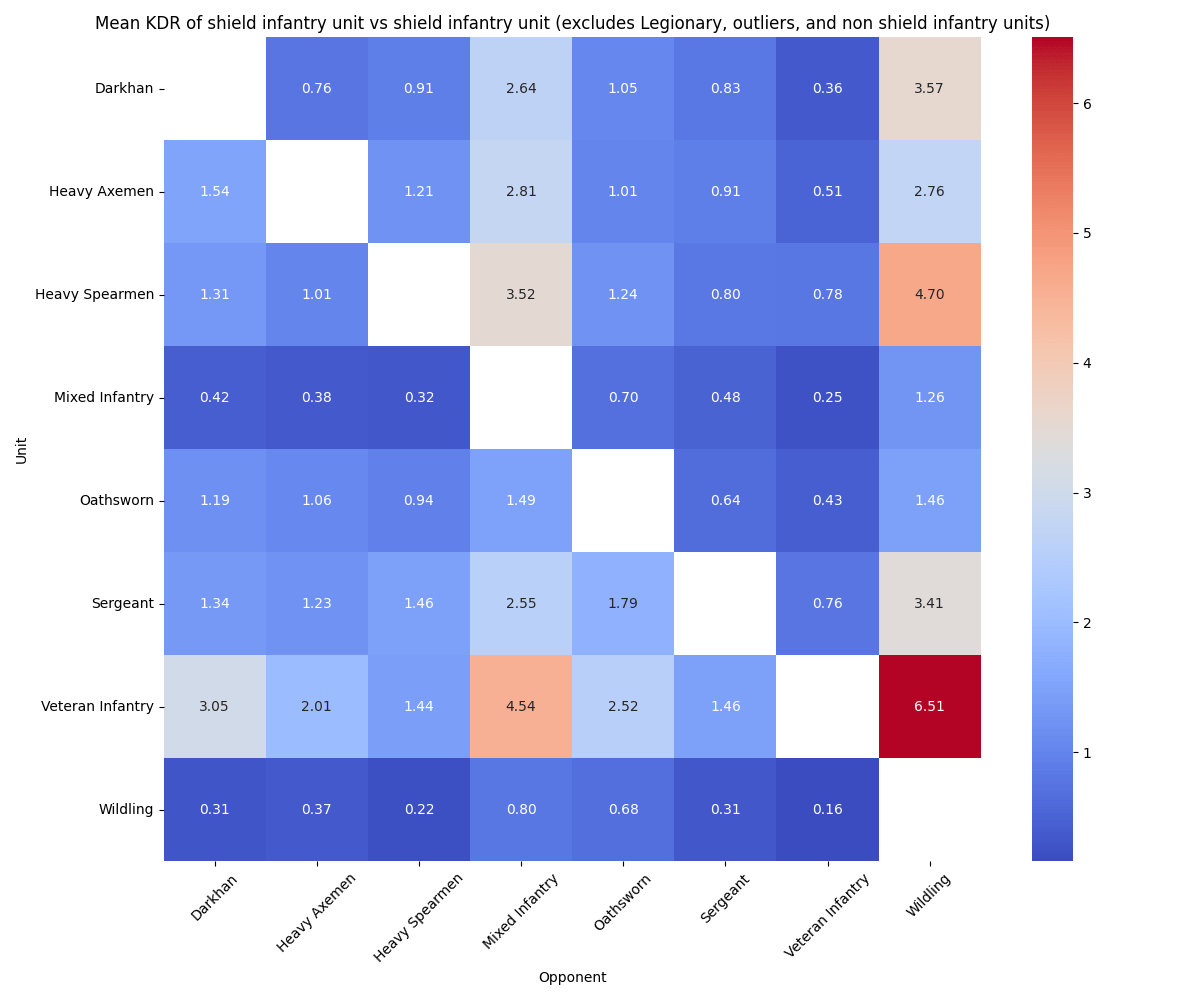
In an attempt to even the playing field, I took out the Legionary out of the calculations to see how the rest of the shield infantry stack up against each other. The data results in the Veteran Infantry emerges as the leading unit, as they never dip below a KDR of 1.44 and peaked at 6.51 against the Wildlings. Close behind are the Sergeants, exhibiting a strong showing across matchups and only faltering against the Veteran Infantry. The Heavy Spearmen and Axemen are close, but I give the edge to the Spearmen since they have higher ceiling and floor in KDR. Oathsworn showed vulnerabilities in three matchups, while the Darkhan floundered in four. At the lower end of the scale, we have the Wildlings, who didn’t manage an average KDR above one in any encounter, suggesting they might be under equipped, low-skilled, or perhaps not utilized to their full potential.
Reassessing the Field Without the Heavy Axemen
The next step is to evaluate without the Heavy Axemen and with the Legionary. Removing the Heavy Axemen from the dataset brings a new perspective on the remaining units. The Legionary consistently holds a KDR above 1 against all opponents, indicating steady performance without the skew of the Heavy Axemen performances. The Veteran Infantry shows a reliable KDR over 1 in most cases, barring their encounters with the Legionary. Sergeants come in with a decent performance, only losing to the Legionary and Veteran Infantry, securing their spot just behind the top two performers.
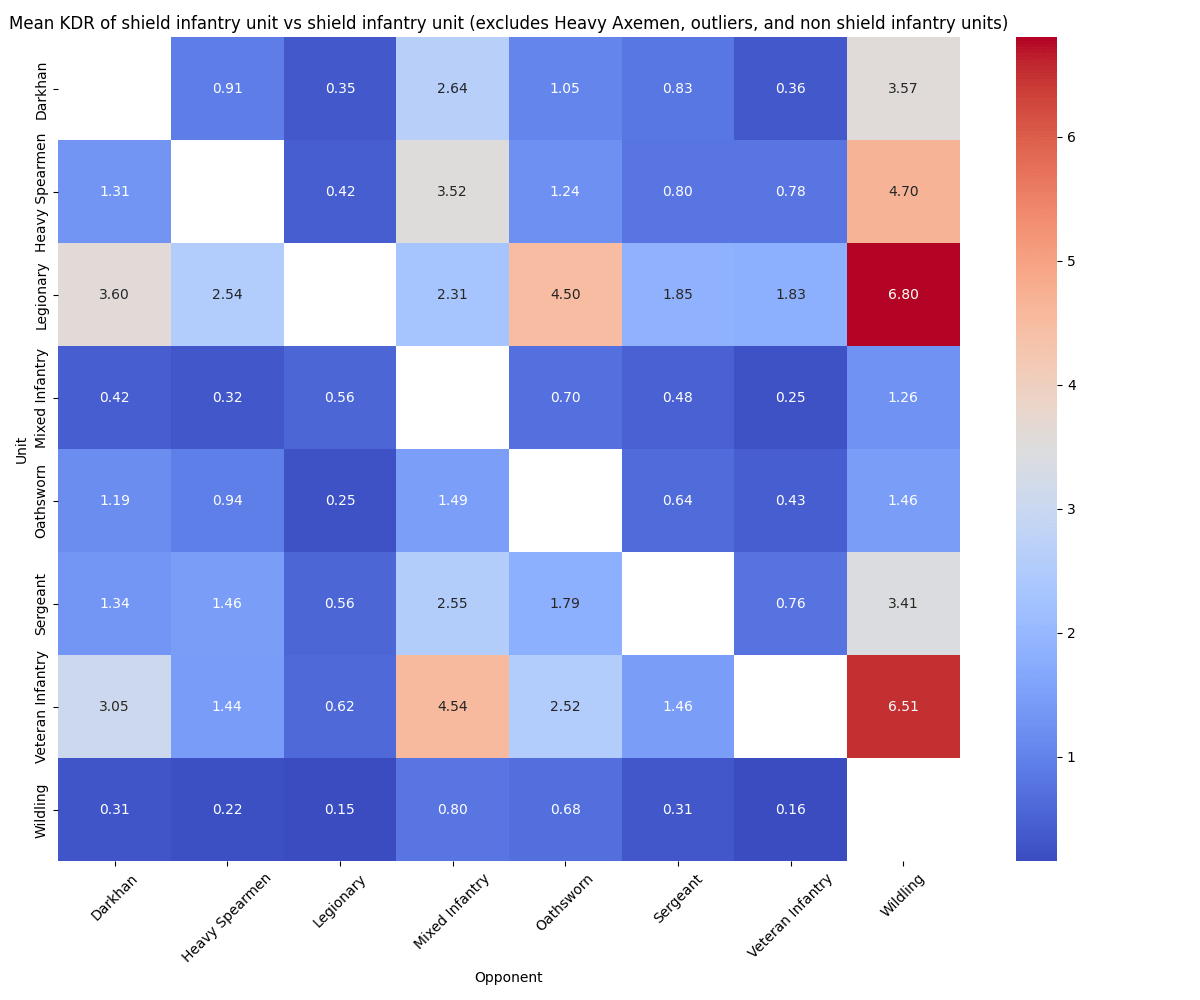
Revisiting KDRs Without the Heavy Axemen
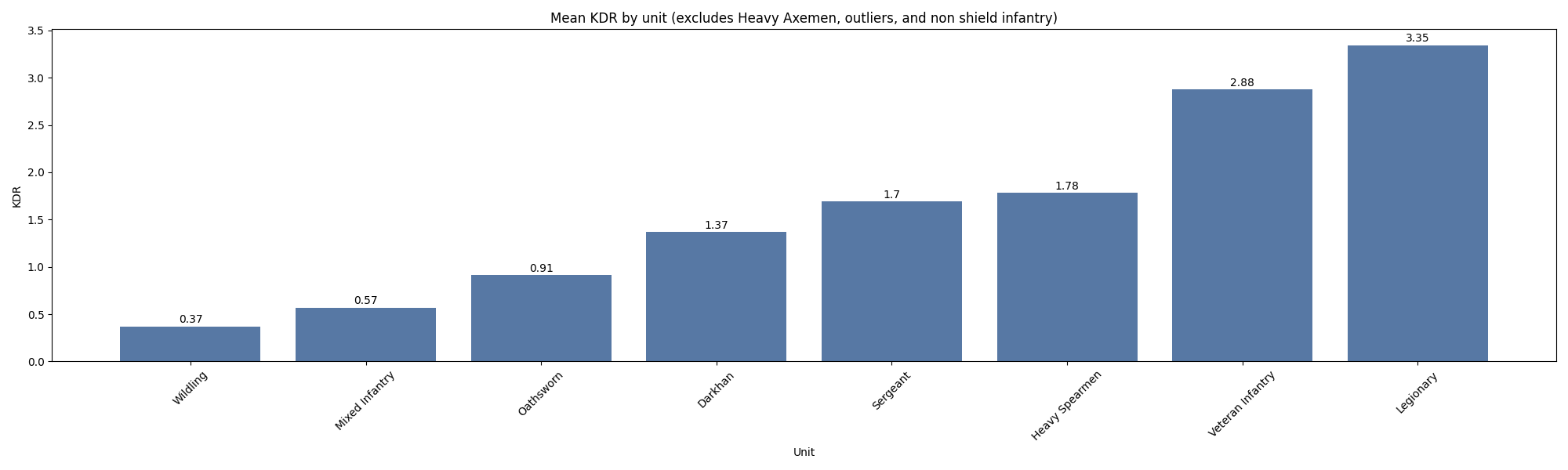
Taking a closer look without the Heavy Axemen, we notice that the gap between the Legionary and Veteran Infantry narrows. The Legionary stands at an average KDR of 3.35, with Veteran Infantry somewhat close behind at 2.88. After these two, there’s a notable drop-off to the Heavy Spearmen with a KDR of 1.78.
It’s interesting to see that while the Heavy Spearmen might have a higher overall mean KDR, the Sergeants have more >1 KDRs against other units, with the Sergeants five and the Spearmen with four. This suggests that while KDR is a helpful metric, it doesn’t always tell the whole story. To get a fuller picture of a unit’s effectiveness, we might also consider their win rates against different opponents.
Understanding Win Rates of Shield Infantry Units
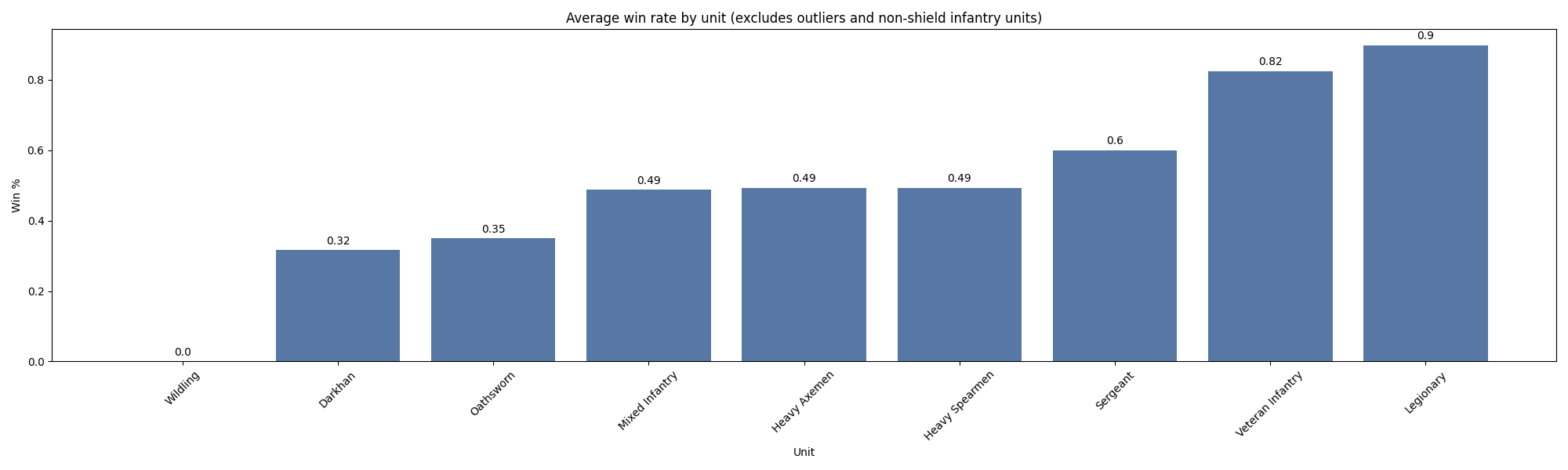
Switching gears to win rates, this bar chart reveals the percentage of victories each shield infantry unit secured in their matchups. The win rate is separate but useful measure—it doesn’t hinge on the scale of the KDR but on whether the unit won or lost, regardless of margin.
The Legionaries are out in front with a commanding 90% win rate. Veteran Infantry isn’t far behind at 82%, while Sergeants secure wins in 60% of their fights. Interestingly, the Heavy Axemen, Heavy Spearmen, and Mixed Infantry hover at 49%. It’s intriguing to note that despite the Heavy Spearmen’s solid KDR, they don’t translate it into wins as frequently as one might expect.
Dropping to the lower end, Oathsworn and Darkhan struggle more, with win rates of 35% and 32%, respectively. At the bottom of the pile, Wildlings failed to notch a single win—a stark contrast to their battlefield counterparts.
Win Rate Analysis of Shield Infantry Units
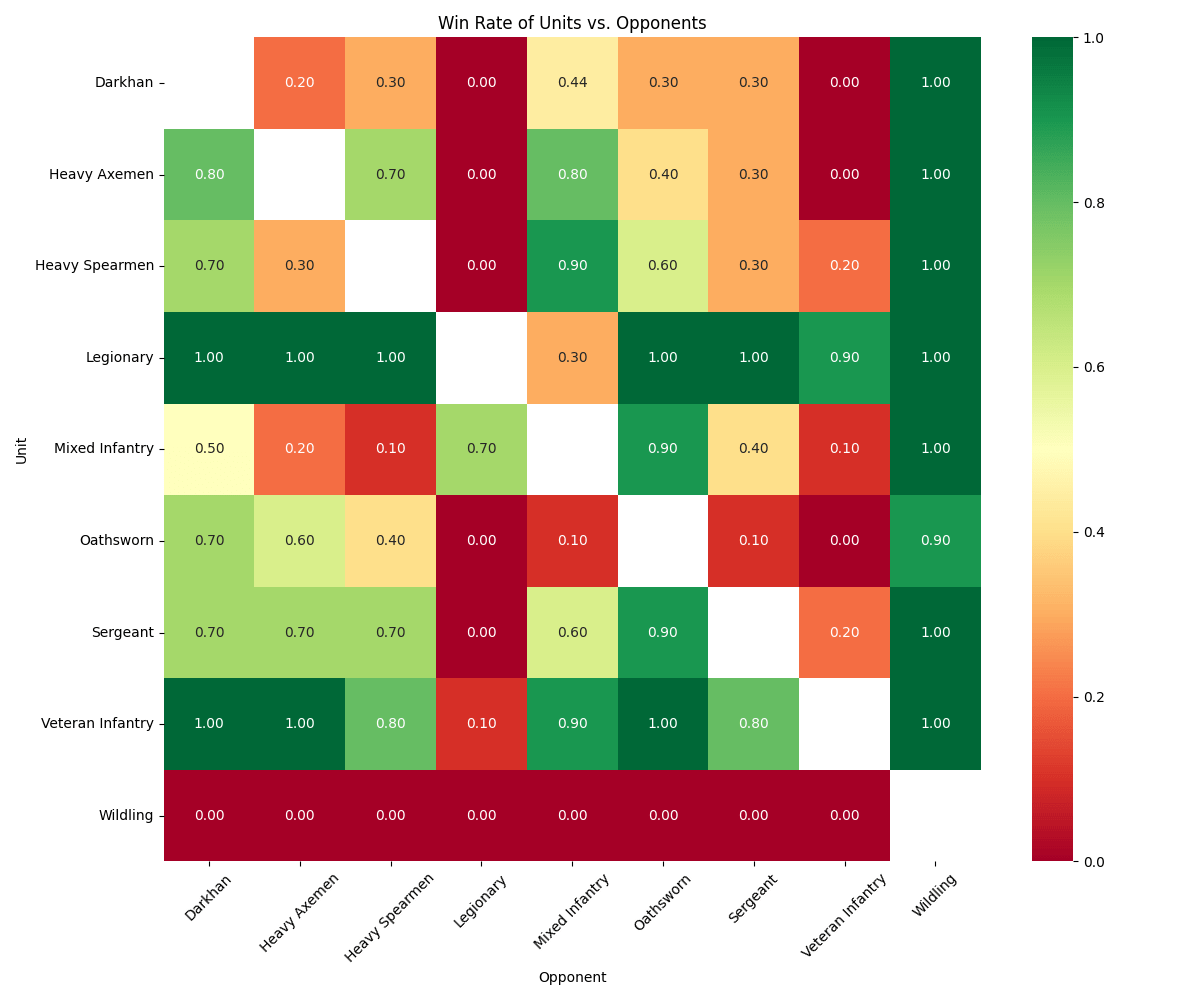
Let’s define a “winning rate” as any scenario where a unit’s win rate against an opponent is 50% or more.
The Legionary has a winning rate against all other units except for the Mixed Infantry, where they only win 30% of the time. Recall that the Mixed Infantry is made up of more lower tier melee units. So, the unit counts are 250 vs 667. The minimum KDR required against Mixed Infantry to be considered efficient (i.e., killing more than dying) is 2.67 (667 divided by 250), and the Legionary have a 2.31 KDR against the Mixed Infantry. This indicates that the Legionary performs extremely well against all units when evenly matched in numbers, however the Legionary are vulnerable when outnumbered.
The Veteran Infantry have winning rates against all other units except for the Legionary. So, the Veteran Infantry can hold their own against almost all units and also when outnumbered. They are only countered by the Legionary.
The Sergeants have a decent win rate against the less efficient units, but are outclassed by the Legionary and Veteran Infantry.
The Heavy Axemen and Spearmen have the same average win rates but the Axemen lose more often than not against the Oathsworn, whereas the Spearmen will win more often against the Oathsworn. However, it’s worth noting that Axemen win against Spearmen 70% of the time.
The Oathsworn, with an average KDR of 0.93 and a 35% win rate, and Darkhan, with a higher average KDR of 1.29 and a lower 32% win rate, reflect an intriguing contrast. The Darkhan does not have a single winning rate except against the Wildings, and the Oathsworn has three winning rates against the Darkhan, Heavy Axemen, and Wildlings. The Darkhan are a more efficient with their higher KDR, but a losing unit. Whereas the Oathsworn are a less efficient but winning unit. The Darkhan seem to fight more evenly matched than the numbers suggest, which possibly means they lose by narrower margins, whereas the Oathsworn’s outcomes are more polarized, hinting at either decisive victories or defeats.
The Wildlings, unfortunately, lag at a 0% win rate, struggling to prove their mettle against any shield unit, making them the least viable option based on our data.
Conclusion and Key Takeaways
After thorough analysis, it’s evident that the Legionary and Veteran Infantry are at the top as the most efficient and winning shield infantry in Bannerlord. Their performance is impressive—they triumph in battles consistently, outclassing other units significantly. On the flip side, the Wildlings were a underwhelming, frequently outperformed by their peers in both KDR and wins.
Here are my major takeaways from examining the data:
- Legionary wins against every other shield infantry unit. Their weakness is when they are outnumbered.
- Veteran Infantry might be the best overall unit since they perform well against larger forces, albeit they are not as efficient as the Legionary and can also be countered by them.
- Sergeants are a solid overall unit, they win against all except Legionary and Veteran Infantry, and can win while outnumbered.
- Heavy Spearmen and Axemen are similar performers, but I give the advantage to the Spearmen since they have a long spear that can counter cavalry units, and they have a better overall KDR.
- Darkhans are not to be underestimated. Though often the losing side, they will can take a lot of the opponent with them to the grave.
- Oathsworn are too unreliable to be considered for your army, they are inefficient (<1 KDR) and have a have a sub 50% win rate.
- Wildlings fall short as a primary shield unit choice due to underwhelming outcomes in combat
It’s worth noting that even though there is a wide spectrum in performance, each unit can be useful if utilized correctly. Ranged attacks were disabled in the data collected and units like Veteran Infantry, Heavy Axemen, and Wildlings come equipped with javelins. This could potentially boost their combat effectiveness by throwing their javelins at the opposing infantry line before meeting in close quarter melee combat. The Veteran Infantry have five javelins, and the Heavy Axemen and Wildlings have ten javelins each. If ranged capabilities were on, then all three could have higher performance outputs.
Furthermore, the role of shield infantry units in Bannerlord extends beyond efficiently killing foes. They’re crucial in holding lines, absorbing ranged fire, and preventing the enemy from advancing. Yet, their success often hinges on support from archers and cavalry, along with strategic commands from the player. I want to emphasize that these units are only a piece of the puzzle for building a successful army. Each unit can be viable for different reasons. For those aiming to assemble an efficient or “perfect” army in Bannerlord, centering your shield infantry around Legionaries or Veteran Infantry would be my suggestion. Here are my final tiered rankings:
– S: Legionary, Veteran Infantry
– A: Sergeant
– B: Heavy Spearmen, Heavy Axemen
– C: Darkhan
– D: Oathsworn
– F: Wildling
Future Considerations
Next steps would be why the Legionary and Veteran Infantry performed well, and why Wildlings underperformed. A common denominator among units are skills, yet disparities in skill levels (like the Veteran Infantry’s one-handed skill of 160 compared to the Wildling’s 120) could play a significant role. Additionally, differences in equipment, such as the superior arm armor of the Legionary relative to that of the Heavy Axemen, may also contribute to the results. Delving into a detailed skill and equipment analysis could shed light on these performance gaps. Understanding how each unit’s arsenal and capabilities translate into performance and efficiency would provide valuable insights.
 Matthew Dane